Describe the Origin and Spread of Islamic Arts Literature Science and Technology
Early Islamic World
Science and Technology
History for Kids >> Early Islamic EarthScientific discipline and Technology flourished during the Islamic Golden Age from around 780 CE to 1248 CE. During this time, scholars in the Eye East made great advances in the areas of mathematics, physics, geography, and medicine.
Why did science technology flourish during this fourth dimension?
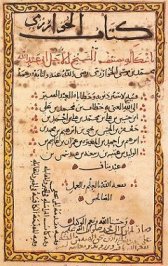
A Page from Algebra by al-Khwarizmi
Source: John L. Esposito
The Oxford History of Islam.
Mathematics
Islamic scholars studied the mathematics of before civilizations in Hellenic republic, India, and China. They and then made advances in many areas including geometry and trigonometry. Perhaps the about of import mathematical advocacy was in the expanse of algebra. Two great Islamic mathematicians, al-Khwarizmi and Omar Khayyam, helped develop algebra into a separate field of mathematics. In fact, the name "algebra" comes from the Arabic "al-jabr", which means "reunion of broken parts."
Astronomy
Astronomy was an important function of Islamic science. Information technology was used for navigation, determining an accurate agenda, and for religious purposes (determining the direction of Mecca and prayer times). Islamic astronomers built large observatories for viewing the stars. They too designed detailed celestial globes showing the positions of the stars and planets in relation to the Earth. New tools were adult including the quadrant and the astrolabe.
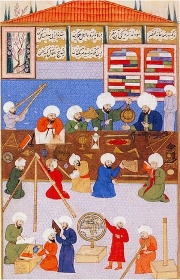
Scientists in an Observatory
by Ala advertisement-Din Mansur-Shirazi
c. 1574-1595.
Medicine
Islamic medicine was well-advanced for this period of time. Doctors were required to attend medical school where they studied the works of the Ancient Greeks and Indians. Islamic scholars added to this work with new medical theories and ideas. Most major cities had a big infirmary where anyone could become to seek healthcare. One of the largest hospitals in Cairo, Arab republic of egypt was said to assistance 4,000 patients a solar day.
I of the most lasting influences of Islamic medicine was a medical book written past Ibn Sina called The Catechism of Medicine. This book was used as the standard medical textbook both in the Islamic world and throughout Europe for hundreds of years.
Engineering science
Due to the scarceness and importance of water in the Eye E, much of the efforts of Islamic engineers went into ways to store and move water. They built dams, irrigation canals, waterwheels, pumps, aqueducts, and cisterns. They also invented diverse ways to measure water and control the period of water.
Islamic engineers also made pregnant contributions in the areas of eyes, mechanics, clocks, current of air power, and chemical science.
Interesting Facts nearly Science and Engineering science in the Islamic Golden Age
- Due to the large libraries and many books produced in the Muslim world, Arabic became the international linguistic communication of science and learning.
- Islamic scholars helped to reproduce the work of many Greek scientists and mathematicians such as Aristotle.
- The work of Islamic astronomers had a significant influence on afterward astronomers such equally Galileo and Copernicus.
- Arab scientist Ibn al-Haytham is considered one of the world's first theoretical physicists. He developed the scientific theory and wrote a famous book on vision and light called the Volume of Optics.
- Have a 10 question quiz about this page.
- Listen to a recorded reading of this folio:
Works Cited
History for Kids >> Early on Islamic World
Source: https://www.ducksters.com/history/islam/science_and_technology.php
0 Response to "Describe the Origin and Spread of Islamic Arts Literature Science and Technology"
Post a Comment